
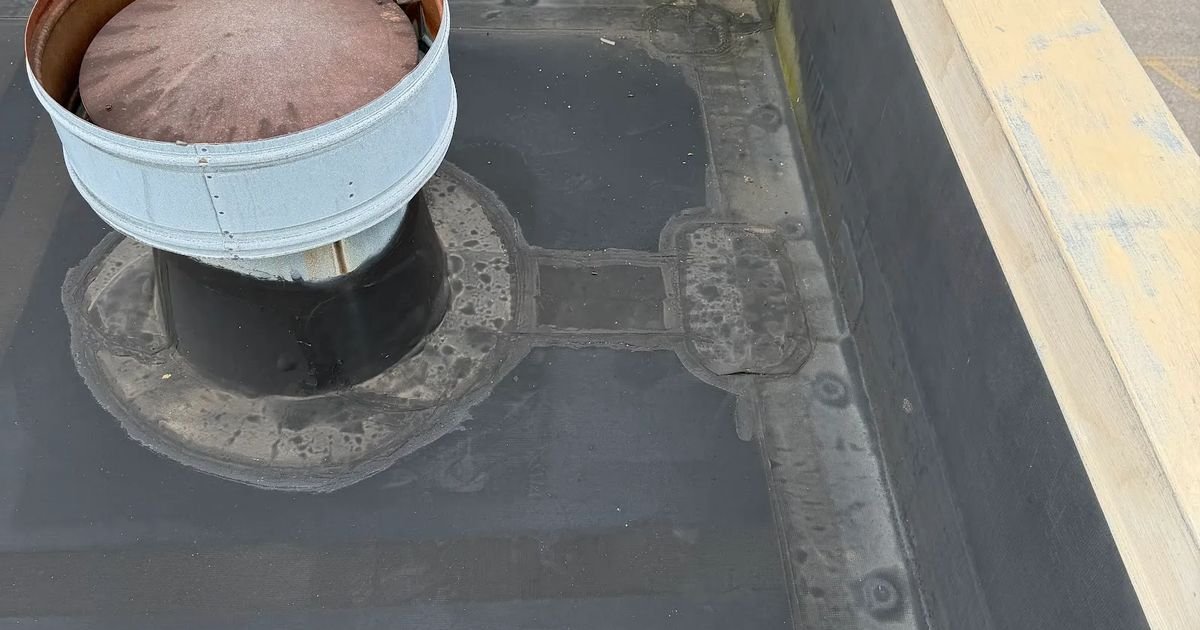
A Central Roof Repair job: membrane roof, vent and perimeter wall during coating prep. The photo shows the perimeter wall, not a drain or scupper.
A flat roof behind a parapet or a raised perimeter wall can’t shed water over its edge. It drains through its drains and scuppers, and when those clog, the wall holds the water in. Kentucky’s building code has a roof drainage section with Kentucky amendments, and it is specific about strainers, overflow drains and scuppers. Here is what it says, and what a repair visit looks at.
Which code covers a commercial flat roof
Kentucky’s building code regulation, 815 KAR 7:120, Section 2, makes the 2015 International Building Code the state code, and “The Kentucky amendments in the 2018 Kentucky Building Code shall supersede any conflicting provision in the 2015 International Building Code.” Section 5 incorporates the “2018 Kentucky Building Code”, Fourth Edition, February 2024. Houses are a separate code: “One (1) family dwellings, two (2) family dwellings, and townhouses shall be governed by 815 KAR 7:125.”
The drainage section is 1503.4. In the Kentucky Building Code, it reads: “The primary and secondary roof drainage systems shall comply with the requirements of Sections 1503.4.1 through 1503.4.2.”
Drains, strainers and drain flashing
- Strainers. Section 1503.4.1.1: “Roof drains shall have strainers extending not less than 4 inches (102 mm) above the surface of the roof immediately adjacent to the roof drain.” The strainer’s inlet area above roof level is “not less than one and one-half times the area of the conductor or leader to which the drain is connected.”
- Drain flashing. Section 1503.4.1.3: “The connection between roofs and roof drains that pass through the roof and into the interior of the building shall be made watertight by the use of approved flashing material.”
The overflow: secondary drains or scuppers
Section 1503.4.2 is the parapet rule: “Where roof drains are required, secondary (emergency overflow) roof drains or scuppers shall be provided where the roof perimeter construction extends above the roof in such a manner that water will be entrapped if the primary drains allow buildup for any reason.”
Two Kentucky details follow:
- Separate piping, visible discharge. Section 1503.4.2.1: “Secondary roof drain systems shall have piping and point of discharge separate from the primary system. Discharge shall be above grade in a location, which would normally be observed by the building occupants or maintenance personnel.”
- Scupper size. Section 1503.4.2.3: scuppers are sized “to prevent the depth of ponding water from exceeding that for which the roof was designed as determined by Section 1611.1.” And: “Scuppers shall not have an opening dimension of less than 4 inches (102 mm).”
Sizing belongs to the plumbing code
Section 1503.4.2.2: “Secondary (emergency) roof drain systems shall be sized in accordance with the Kentucky State Plumbing Code based on the rainfall rate for which the primary system is designed. The secondary drain system shall be equal in size to the primary drain system.” Sizing new drain piping is design and plumbing work, which goes to the design professional and a licensed plumber.
What a repair visit looks at
Our flat-roof drainage work covers: “Clear and repair drains, scuppers, and overflow paths” and “Rebuild sump details and re-flash drain bowls.” On a repair visit, we check:
- The strainer. Is it there, and is it clear?
- The drain flashing. Is the connection at the drain bowl watertight?
- The overflow. Where the perimeter wall would trap water, is there a secondary drain or scupper, and is it open?
- The discharge. Where does the overflow come out?
This is general information about the Kentucky Building Code, not legal advice. The local building official has the final word on a specific building.
Set up a repair inspection
Seeing water stand behind the parapet on a flat roof around Beattyville or the Red River Gorge? Call Central Roof Repair at (859) 310-1209 and set up a repair inspection. We’ll look at the drains, strainers and overflow, tell you what we see, and put a repair scope in writing.
By Central Roof Repair
Leave a Reply