Barn & Outbuilding Roof Repair
The hay doesn’t care about the roof. It cares about staying dry.
The Straight Answer
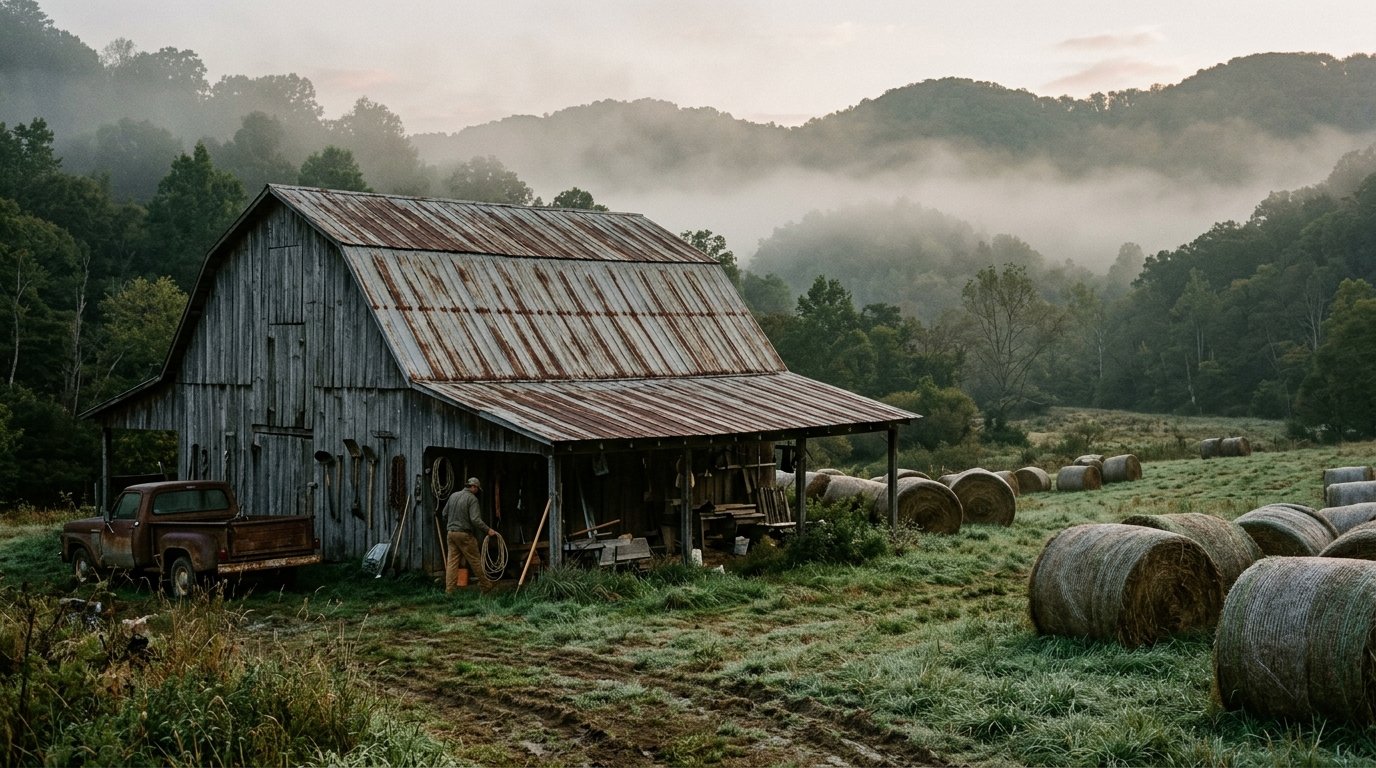
Barn roof repair in our corridor is mostly metal problems with wood underneath: fasteners backed out and gaskets gone, rust tracking down panel lines, purlins sagging or split where water got in, ridge caps loosened by wind. Most are repairable for far less than a re-roof, and keeping the hay, equipment, and stock dry is the whole point. And sometimes the honest counsel is that the building itself isn’t worth the roof — we’ll say that plainly when it’s true.
Roof problem? Text a photo to (859) 310-1209 — free diagnosis, straight answer.
What actually fails on barn roofs
Screw-down metal barn roofs fail at predictable points. Exposed fasteners work loose as panels expand and contract through Kentucky seasons; their neoprene gaskets dry out and split, and every failed fastener is a slow drip onto whatever’s below. Rust starts where galvanization is scratched or panels overlap and hold moisture, then tracks down the ribs. Wind lifts ridge caps and panel edges on open-field barns that take gusts broadside. Inside, the story shows as darkened purlin lines and daylight at fastener holes. Almost all of it is repairable in place — a fastener-and-gasket round with targeted panel work buys years. The wind events flagged by NWS Jackson (weather.gov/jkl) are what find loose panels first — a fastener round before wind season beats one after.
Purlins, framing, and what a sag means
Look down a barn roofline: a smooth plane means the frame is carrying; visible sags between trusses usually mean purlins — the horizontal boards the panels screw to — have split, rotted at old leak points, or lost their fastener grip. Sagging purlins let panels flex, which backs out more fasteners, which admits more water: the spiral that takes barn roofs from repair to loss. Caught early, we sister or replace purlins from below or with panels lifted, part of our carpentry and rot repair work. Caught late, the framing conversation gets bigger — which is where the honest-counsel section below comes in.
Keep-the-hay-dry practicality
Barn work is practicality work. A hay barn doesn’t need a house roof; it needs no drips on stored rounds, sound purlins, and panels that will hold through wind season — repairs scoped to that standard cost real money less than aesthetic perfection. Equipment sheds justify weathertightness over the parking lines and stalls justify it over the stock. We scope barn repairs to the building’s actual job and say so in the estimate, using the same ranged-and-dated pricing practice as the cost guide — barn ranges get quoted per building because size, height, and access swing them widely. Winter prep matters here too: our winterization checks cover outbuildings on request.
When to let a building go
Sometimes the roof repair is sound and the building isn’t. Rotted sills and racked frames, foundations heaved past straightening, a structure that no longer serves the farm — putting a good roof on a failing frame buys little, and we would rather lose that job than take it. Our rule: we tell you what the frame says before quoting what the roof needs. Options from there run from stabilize-and-use, to salvage (old barn wood has real value), to letting it come down. Disclosure, since land decisions border real estate decisions: owner Marcos Gil is also a licensed REALTOR® (marcosgilrealty.com) — when counsel drifts from carpentry toward property value, you know the interest.
Common Questions
Can you replace just a few damaged panels?
Usually yes. Individual panels unscrew and swap if matching profile and gauge can be sourced — common corrugated and rib profiles usually can. New panels will read brighter than weathered neighbors; on a working barn most owners rightly don’t care. If a profile is obsolete, options are adapting a close match with proper flashing or re-roofing the affected plane. Photos of the panel profile tell us quickly.
Is coating a rusty barn roof worth it?
Sometimes. Surface rust on structurally sound panels can be prepped and coated to buy meaningful life — we do coating work on metal and membrane roofs. Rust that has perforated panels or lives in the overlaps is past what a coating honestly fixes; coating over holes is cosmetics on a leak. We’ll tell you from photos which side of that line your roof is on before anyone spends money.
Do you work on farm buildings with animals inside?
Yes, with planning. Stock stays in the barn more often than people expect — we schedule around feeding, keep noise-heavy work in defined windows, and never drop panels or fasteners where animals move. Metal-roof debris and horses are a bad mix, so cleanup runs continuous with magnetic sweeps, not end-of-job. Tell us what lives there and we’ll plan around them.
Metal specifics live at metal roof repair; framing and purlin work at carpentry & rot repair; the whole repair-first catalog is on our roof repair page.
Central Roof Repair · Beattyville, KY · Repair-first roofing & exterior work across the Lexington-to-Gorge corridor · Owner Marcos Gil is also a licensed Kentucky REALTOR® (marcosgilrealty.com) and publishes Invest in the Gorge — those interests are disclosed in writing wherever they touch your project.
Text a photo of the barn roof
Last updated: August 14, 2026