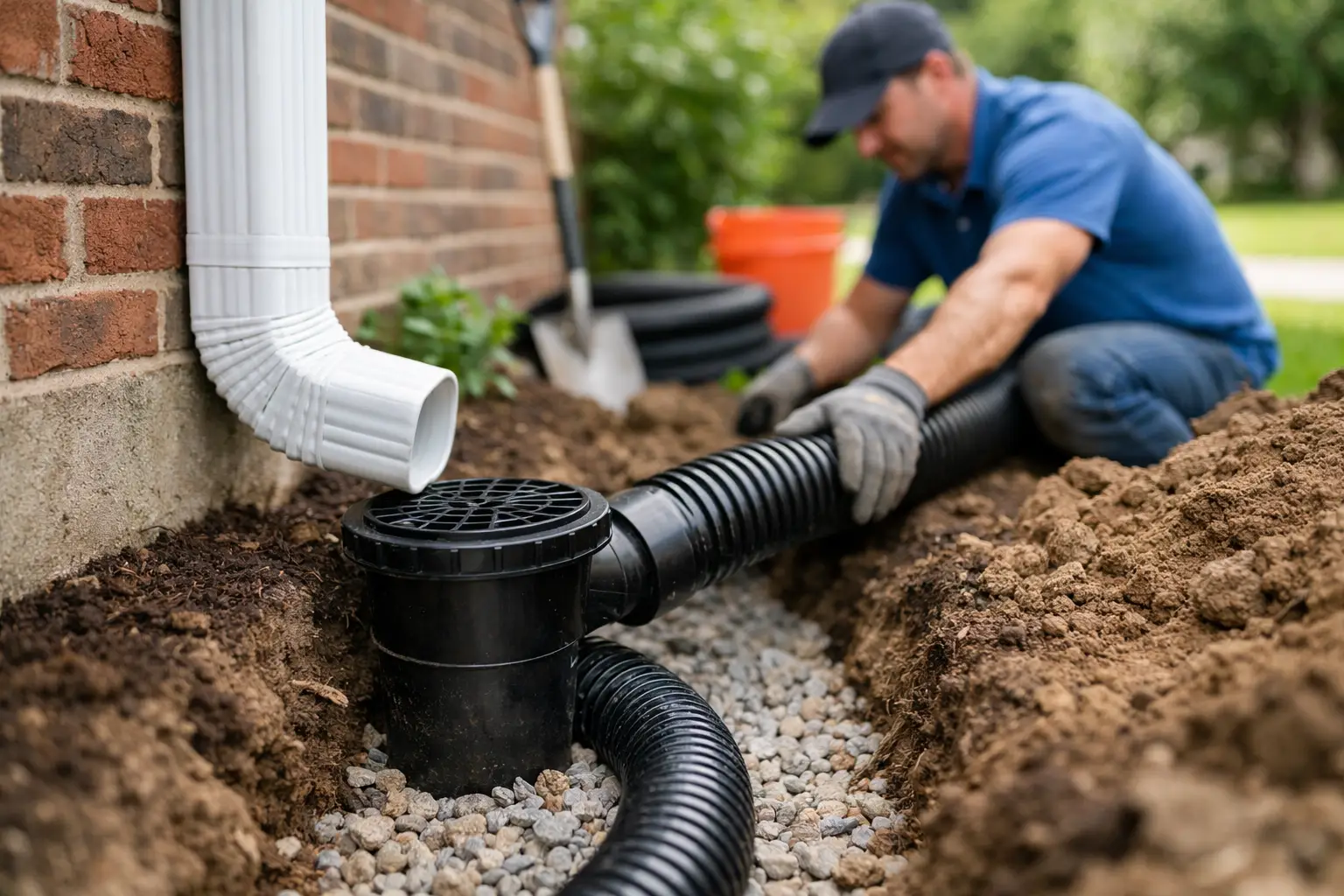
A downspout that dumps water beside the house is not doing its job. Downspout drainage repair Kentucky property owners need is about getting roof runoff safely away from the foundation, crawl space, siding, and the wood the weather gets to first. In the Red River Gorge region, steep terrain, hard rain, leaf-heavy woods, and cabins that sit empty for days can turn one bad downspout into rot, erosion, or a wet basement fast.
The good news is that many drainage problems can be repaired without tearing up the entire yard or replacing every gutter. The right fix depends on where the water starts, where it is landing, and whether the ground can carry it away.
What a Failed Downspout Looks Like
Some drainage failures are obvious. Water pours over the gutter edge during a storm, a downspout has come loose from the wall, or the bottom elbow is crushed. Others show up farther down the line: mulch washed out of a bed, mud splashed up the siding, a trench cut through the yard, or a damp smell in the crawl space.
At cabins and rental properties, owners often first hear about the problem from a guest. There may be water dripping onto a porch entry, a puddle near the steps, or a wet spot under a window after a heavy rain. That is worth checking quickly. Water near the structure rarely stays a small problem when it keeps happening.
Look for these warning signs after a storm:
- Water standing against the foundation or below the deck
- Downspouts that end less than a few feet from the building
- Gutters overflowing even though the downspout appears connected
- Loose brackets, split seams, crushed elbows, or disconnected extensions
- Soil erosion, exposed roots, washed-out gravel, or peeling siding paint
- Damp crawl spaces, basement seepage, mildew, or soft wood around lower walls
A gutter can be clean and still drain poorly. A downspout can be clear at the top but clogged in an elbow, packed with wet leaves at the outlet, or connected to an underground line that has collapsed. That is why a good repair starts with following the path of the water instead of guessing from the ground.
Downspout Drainage Repair Kentucky Properties Often Need
The first repair may be as simple as reconnecting a loose section, replacing a damaged elbow, or securing the downspout with proper straps. If water is shooting out at a joint, leaking seams can be sealed or the failed section can be replaced. These are small repairs, but they matter because a steady leak against siding or trim can create hidden rot.
Clogs are another common issue. Leaves, shingle grit, pine needles, and roof moss wash into the gutter system. Valleys full of leaves are how cabin roofs die, and the same debris can choke a downspout until water has nowhere to go except over the gutter. Cleaning the gutter is only part of the job. The downspout needs to be flushed and checked all the way to the discharge point.
For many homes, the bigger issue is discharge distance. Water should not stop at the foundation line. A properly placed extension, splash block, or above-ground drain route can move runoff farther into a stable area of the yard. On a sloped lot, the outlet needs to be aimed where it will not cut a channel downhill, soak a driveway, or send water toward a neighbor’s property.
Underground drain lines can be a clean-looking option, especially around porches, walkways, and rental cabins. But buried pipe is not automatically better. It can fill with sediment, freeze, separate at fittings, or collapse if it was installed too shallow or without enough slope. Before replacing buried drainage, the line should be inspected for blockage, damage, and a usable outlet. A pipe that carries water underground only to release it against the foundation is not a repair.
Why Kentucky Terrain Changes the Fix
Flat suburban lots and wooded mountain properties do not drain the same way. Around Beattyville, Slade, Campton, Stanton, and the surrounding counties, many properties sit on hillsides, near rock shelves, or in soil that gets saturated during long rain events. Water moves fast until it finds a low spot, then it stays there.
That makes simple extensions useful in some locations and risky in others. Sending water ten feet downhill may be enough for one house. At another cabin, it may wash out a path, undermine a retaining edge, or create a slick spot where guests park. Drainage repairs should protect both the building and the way people use the property.
Roofs also matter. Metal roofs shed water quickly and can overwhelm undersized gutters or short downspouts during a hard rain. Large cabin roof planes do the same. If a single downspout handles too much runoff, adding capacity or correcting the gutter layout may be more effective than repeatedly repairing the same washed-out area below.
Trees add another layer. Leaves and twigs are part of life in the Gorge, not a one-time fall cleanup issue. Heavy canopy means gutters and outlets may need seasonal attention, especially before winter and before the spring rain cycle. Deferred maintenance is cheaper until water gets into wood framing, crawl spaces, or guest areas. Then it is not deferred maintenance anymore. It is damage control.
Repair First, Then Improve the Drainage Path
A straight answer begins with finding the actual failure. If the downspout is disconnected, repair it. If the gutter is pitched wrong or clogged, correct that first. If the outlet is too close to the house, extend it to a stable discharge area. Full replacement is not the answer every time, and neither is burying pipe just because it looks tidier.
For a remote cabin owner, documentation matters as much as the repair. You should be able to see the loose section, clogged outlet, washed-out ground, or failed connection before work starts. After the repair, you should be able to see where the water will now go. Central Property Services provides before-and-after photos so owners who live hours away are not left wondering whether the problem was actually handled.
There are times when drainage repair needs to be coordinated with other work. Rotten fascia can prevent a gutter from staying secure. Damaged siding may need a patch where overflow has been hitting for years. A roof valley that constantly sheds debris into one gutter may need cleaning and maintenance before any downspout fix will hold up. Treating one part while ignoring the source is how the same call comes back after the next storm.
When to Call Before the Next Rain
Call or text for an inspection when you see foundation pooling, washouts, gutter overflow, basement moisture, or a downspout that has separated from the building. It is also smart to act before a busy rental weekend if water is crossing a walkway, pouring onto a deck, or creating mud near the entry. Guests notice drainage problems quickly, and wet steps are more than an appearance issue.
Emergency attention is especially warranted after high wind or a storm that tears gutters loose. A hanging gutter can pull on fascia boards, and a detached downspout can concentrate roof runoff in one damaging spot. A temporary redirect may protect the property until a permanent repair can be completed.
For commercial buildings, churches, multi-unit rentals, and properties with several structures, drainage should be checked as a system. One blocked leader can overload a roof edge, while a failed underground drain can send water into a walkway or parking area. Regular maintenance is usually less disruptive than waiting for a storm to expose every weak point at once.
Water always takes the easiest route. The job is to make sure that route leads away from your foundation, away from vulnerable wood, and away from the places people walk. A small downspout repair completed before the next hard Kentucky rain can save a cabin, home, or rental property from a much bigger repair later.
Leave a Reply